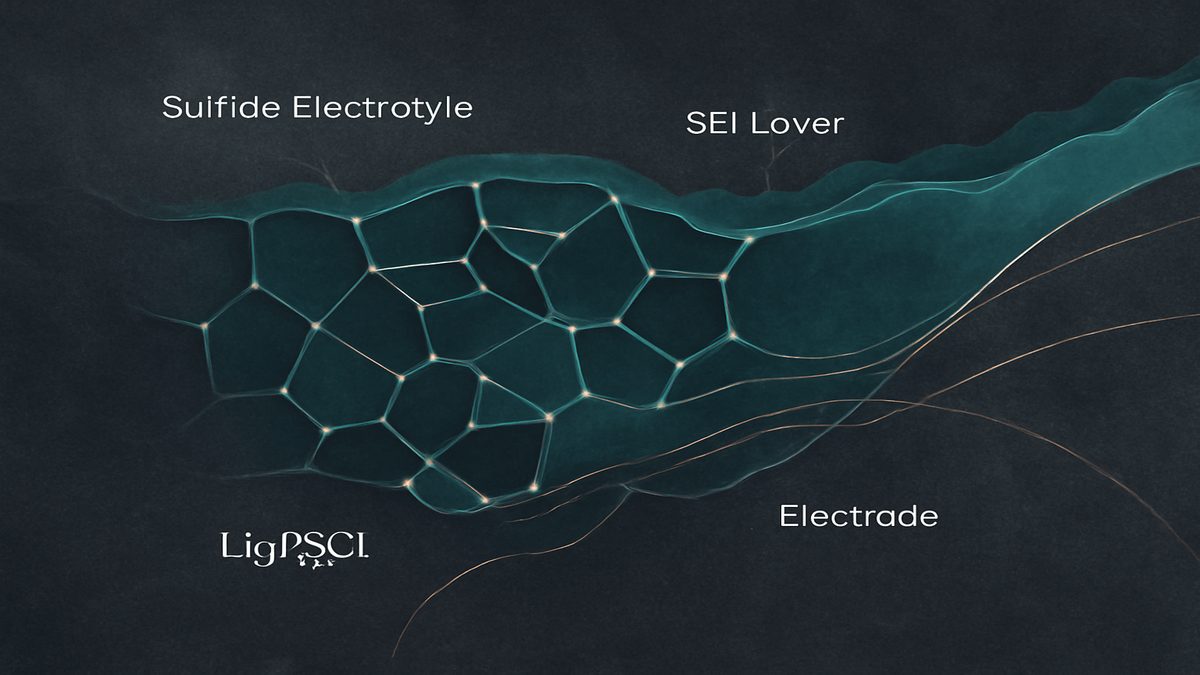
Interface stability under realistic exposure and cycling conditions remains the dominant constraint in solid-state systems, where moisture attack, mechanical ductility, and SEI growth kinetics must be treated as coupled variables rather than isolated material properties.
The supplied reports this week converge on two practical questions. First, how does trace moisture under dry-room conditions alter the surface chemistry of sulfide electrolytes such as argyrodite Li6PS5Cl, and what spatial resolution is required to map the resulting degradation products? Second, whether existing models of SEI growth can be made to respect physical rate laws across varying protocols without overfitting to single datasets.
These questions matter because dry-room processing is already the industrial baseline, and any moisture-driven surface reconstruction directly affects critical current density and stack-pressure requirements. Modeling frameworks that embed Arrhenius kinetics for SEI growth and lithium inventory loss offer one route to test consistency, yet they still require validation against spatially resolved post-mortem data.
The essentials
Moisture-driven surface changes in argyrodite. A study maps the chemical evolution of Li6PS5Cl surfaces when exposed to controlled humidity levels representative of dry-room environments, showing that even low moisture partial pressures produce detectable surface species that alter interfacial impedance.
Correction on SEI mechanical properties. An author correction to earlier work on a ductile solid electrolyte interphase clarifies the mechanical characterization conditions and the extent to which ductility claims depend on specific electrolyte formulations and cycling parameters.
Physics-informed SOH modeling. The PiDDM framework incorporates empirical Arrhenius terms for SEI growth and lithium inventory loss directly into the training loss, reducing physically implausible extrapolation on a public dataset of 55 cells cycled under varied conditions.
Spatially resolved diffraction for degradation mapping. A μ-XRD workflow applied to inhomogeneous polycrystalline samples demonstrates how hundreds of micron-scale diffraction patterns can be processed to extract local phase fractions and strain distributions linked to degradation.
Polymer electrolyte solvation control. Work on quasi-solid-state sodium metal cells shows that tuning the solvation structure within a polymer matrix improves interfacial stability, although the precise balance between ionic transport and reductive stability at the sodium surface remains to be quantified.
Mechanism and evidence
The clearest mechanistic signal concerns moisture attack on sulfide surfaces. The argyrodite study isolates the chemical steps that convert Li6PS5Cl into surface phosphates or oxides under dry-room humidity, directly linking these products to increased charge-transfer resistance. Evidence quality is moderate: the work reports surface-sensitive measurements but does not yet provide full cell-level cycling data under the same exposure conditions. Complementary μ-XRD work supplies a route to map the spatial extent of such degradation products inside composite electrodes, yet the analysis pipeline still requires manual intervention for phase identification across thousands of patterns. The PiDDM approach tests whether embedding known SEI kinetics improves long-term extrapolation, but its performance on solid-state rather than liquid systems is not addressed.
Materials and interfaces
Surface reconstruction of argyrodite and the mechanical properties of the resulting interphase dominate the interface discussion. The correction to the ductile-SEI paper underscores that measured ductility can depend on the precise stack pressure and temperature window used during testing, limiting direct transfer to other sulfide or oxide systems. Polymer-electrolyte work on sodium cells points to solvation-sheath engineering as a lever for reducing continuous SEI growth, yet the trade-off between bulk ionic conductivity and the stability of the sodium-polymer boundary is not fully resolved. No new bulk cathode or anode compositions are introduced; the emphasis remains on how existing materials respond once interfaces are exposed to realistic processing or cycling environments.
Scale-up, safety and manufacturing
A standardized battery database initiative highlights the inconsistency in reported metadata across thousands of published solid-state device papers, which directly limits the training of AI models intended to guide electrolyte or interface design. Without uniform reporting of cell format, stack pressure, electrolyte loading, and post-mortem conditions, cross-study comparisons remain unreliable. The hidden-flaw report on high-nickel cathodes flags a materials-level degradation pathway that could affect lifetime in cobalt-free cells, but the underlying mechanism and its dependence on electrode loading or electrolyte formulation are not detailed. No manufacturing-scale process data or safety-test results are supplied.
Quick Radar
- The μ-XRD pipeline still requires substantial manual input for Rietveld refinement across variable phase mixtures.
- PiDDM validation is limited to liquid-electrolyte cells; extension to solid-state interfaces is not shown.
- Moisture-induced species on Li6PS5Cl are identified, but their effect on critical current density under applied pressure is unreported.
- The ductile-SEI correction leaves open whether the revised mechanical values hold across different sulfide chemistries.
- Polymer-electrolyte sodium cells improve interface stability via solvation tuning, yet the sodium stripping-plating overpotential window is unspecified.
- A proposed battery database aims to standardize metadata, but adoption criteria and minimum reporting fields are not defined.
- Thermal-runaway modeling for large-face liquid-cooled packs addresses propagation, yet the cell-to-cell variability in onset temperature remains unquantified.
Closing
The practical question for the coming week is whether moisture-exposure protocols used in the argyrodite study can be combined with stack-pressure cycling to produce a single, transferable metric for interfacial stability.
Sources
- Nature Portfolio - Batteries: Author Correction: A ductile solid electrolyte interphase for solid-state batteries - https://www.nature.com/articles/s41586-026-10945-2
- Nature Portfolio - Batteries: Moisture-induced surface degradation mechanism of argyrodite Li6PS5Cl under dry-room conditions - https://www.nature.com/articles/s41467-026-75537-0
- arXiv - Battery degradation query: Automating the analysis of micron-scale synchrotron diffraction data on inhomogeneous polycrystalline samples: a solid oxide electrolysis cell case study - https://arxiv.org/abs/2607.28859v1
- Tech Xplore - Energy & Green Tech: Standardized battery database could improve AI-guided solid-state battery design - https://techxplore.com/news/2026-07-standardized-battery-database-ai-solid.html
- arXiv - Battery interphase query: PiDDM: Physics-Informed Differentiable Degradation Modeling for Lithium-Ion Battery State-of-Health Prediction - https://arxiv.org/abs/2607.29095v1
- Tech Xplore - Energy & Green Tech: Hidden battery flaw may shorten EV lifespans - https://techxplore.com/news/2026-07-hidden-battery-flaw-shorten-ev.html