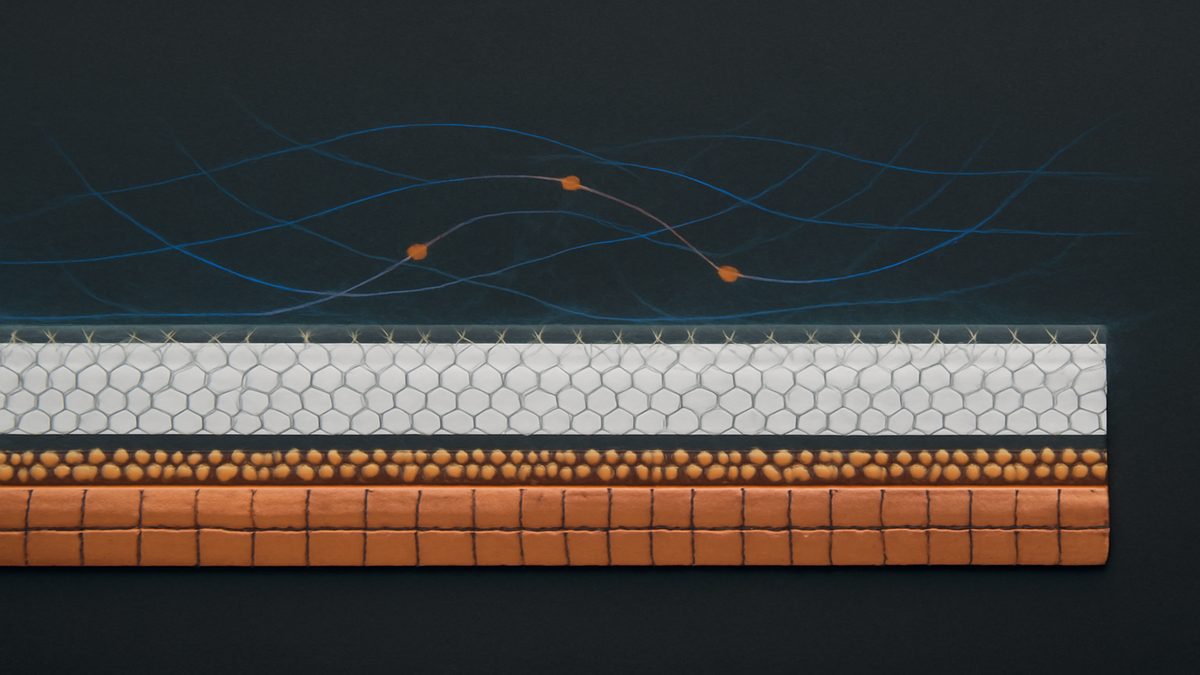
Interfacial pressure, lateral conductivity and anion dynamics jointly set the stability of metal-electrolyte contacts rather than acting as independent levers.
Stack pressure is routinely applied in all-solid-state cells to maintain contact, yet its chemical consequences at reactive interfaces remain poorly quantified. Recent modeling shows that modest compression can accelerate decomposition pathways while higher loads suppress long-range ordering, indicating that the same variable can either promote or inhibit interphase growth depending on magnitude and geometry. Parallel work on aqueous zinc systems demonstrates that an ultrathin conductive mesh can redistribute electrons laterally without blocking ion access, pointing to spatial control of the electric field as an additional design axis. These observations converge on a picture in which local mechanics, electron transport and anion motion must be treated together when interpreting cycle-induced changes at the electrode-electrolyte boundary.
The same coupling appears in polymer and halide electrolytes, where coatings or lattice substitutions alter both ionic pathways and electronic leakage. When electronic conductivity in the electrolyte is non-negligible, physical self-discharge becomes measurable even in the absence of faradaic side reactions. Such findings shift attention from headline conductivity values toward the narrower question of how pressure, surface chemistry and anion polarizability together determine whether an interface remains passivating or continues to evolve.
The essentials
Pressure-dependent interphase ordering. Molecular-dynamics trajectories of Li||Li6PS5Cl interfaces reveal a non-monotonic response: 1 kbar compression promotes PS4 decomposition and Li2S-like ordering, whereas 10-100 kbar restricts rearrangement and crystallization. Charge-resolved dynamics locate the early sulfur-centered, lithium-rich nuclei whose growth is mechanically gated.
Lateral electron redistribution at zinc interfaces. An ultrathin two-dimensional Au aerogel mesh placed at the Zn surface spreads electron transport while preserving open ion pathways. The mesh therefore decouples the evolving Zn/electrolyte contact geometry from localized field intensification that otherwise drives nonuniform plating.
Ceria-mediated transport-compatibility trade-off. Coating composite polymer electrolytes with ceria reconciles bulk ionic conductivity with lithium-metal compatibility. The coating modifies the polymer-ceramic boundary without introducing new high-resistance layers, yet the precise location of the conductivity gain relative to the lithium interface remains to be mapped.
Anion-motion dominance in solid electrolytes. Disentangling cation-polyanion coupling shows that anion dynamics, rather than cation hopping alone, control net transport in several families of solid electrolytes. The result reframes fast-charging limits as a question of lattice polarizability and steric constraints on anion displacement.
Low-temperature solvation and conductivity modeling. Molecular-dynamics and Gaussian-process surrogates applied to EC/EMC/FEC electrolytes quantify how fluorinated-additive content alters Li+ coordination and conductivity between 298 K and 233 K. The approach isolates solvent-composition effects that remain unresolved in experimental low-temperature cycling.
Mechanism and evidence
The clearest mechanistic signal is the mechanical gating of interphase chemistry at sulfide interfaces. Pressure-aware, charge-resolved machine-learning molecular dynamics directly link compression geometry to the formation of specific sulfur-rich nuclei, validated against DFT. The non-monotonic dependence supplies a concrete variable that can be tested in pellet or stack-pressure cells, provided post-mortem diffraction or spectroscopy confirms the predicted ordering. Evidence quality is high for the simulated trajectories but still requires experimental replication under controlled loading conditions.
Materials and interfaces
Work on zinc and lithium-metal interfaces converges on the need to regulate both ion access and electron distribution at the evolving contact plane. The Au mesh and ceria-coating studies each address one side of this requirement without yet demonstrating combined performance in full cells. In parallel, anion-motion analysis in solid electrolytes highlights lattice chemistry as a lever for transport that is independent of bulk conductivity optimization. Oxygen K-edge modeling of NCM-811 degradation products offers a separate but complementary route to identify early lattice-oxygen redox signatures before they evolve into inactive phases.
Scale-up, safety and manufacturing
No items in the supplied material supply concrete manufacturing constraints, formation protocols or safety-test data at cell or pack level. Commercial supply agreements and coating-equipment positioning statements remain at the level of intent rather than validated process windows.
Quick Radar
- Prototype-guided transfer learning is being applied to prioritize boron-containing electrolyte additives from 179,977 unlabeled candidates using 126 literature examples.
- In situ Raman spectroscopy continues to be positioned as a tool for real-time interphase tracking, yet cell-format constraints on optical access remain unaddressed.
- Nitrogen/oxygen anion substitution in zirconium chlorides is reported to induce amorphization that improves both conductivity and deformability, but critical current density under stack pressure is not stated.
- Surface-welded SWCNTs on red-phosphorus anodes are claimed to suppress chemo-mechanical degradation in sodium-ion cells, yet electrode loading and cycle-window details are absent.
- SK On’s LFP pouch-cell supply agreement specifies 9 GWh over five years but provides no formation or calendar-aging protocol.
Closing
How does the pressure threshold that separates accelerated versus suppressed interphase growth shift when the same sulfide electrolyte is paired with different lithium-metal surface terminations?
Sources
- arXiv - Battery interphase query: An Ultrathin Laterally Conductive Mesh Interphase Enables Spatially Extended Zinc Deposition for Aqueous Zinc Batteries - https://arxiv.org/abs/2609.03176v1
- Nature Portfolio - Batteries: Disentangling cation-polyanion coupling reveals which anion motion dominates cation transport in solid electrolytes - https://www.nature.com/articles/s41467-026-77273-x
- arXiv - Battery electrolytes query: Low-Temperature Transport in Li-Ion Battery EC/EMC/FEC Electrolytes: Molecular Dynamics and Machine-Learning Modeling - https://arxiv.org/abs/2609.02824v1
- arXiv - Battery interphase query: Pressure-regulated mechanochemistry at lithium metal-sulfide electrolyte interfaces - https://arxiv.org/abs/2609.01088v1
- EKL Batteries: Interface Engineering via Ceria Coating Reconciles Ion Transport and Lithium Compatibility in Composite Polymer Electrolytes - https://advanced.onlinelibrary.wiley.com/doi/10.1002/aenm.71551?af=R