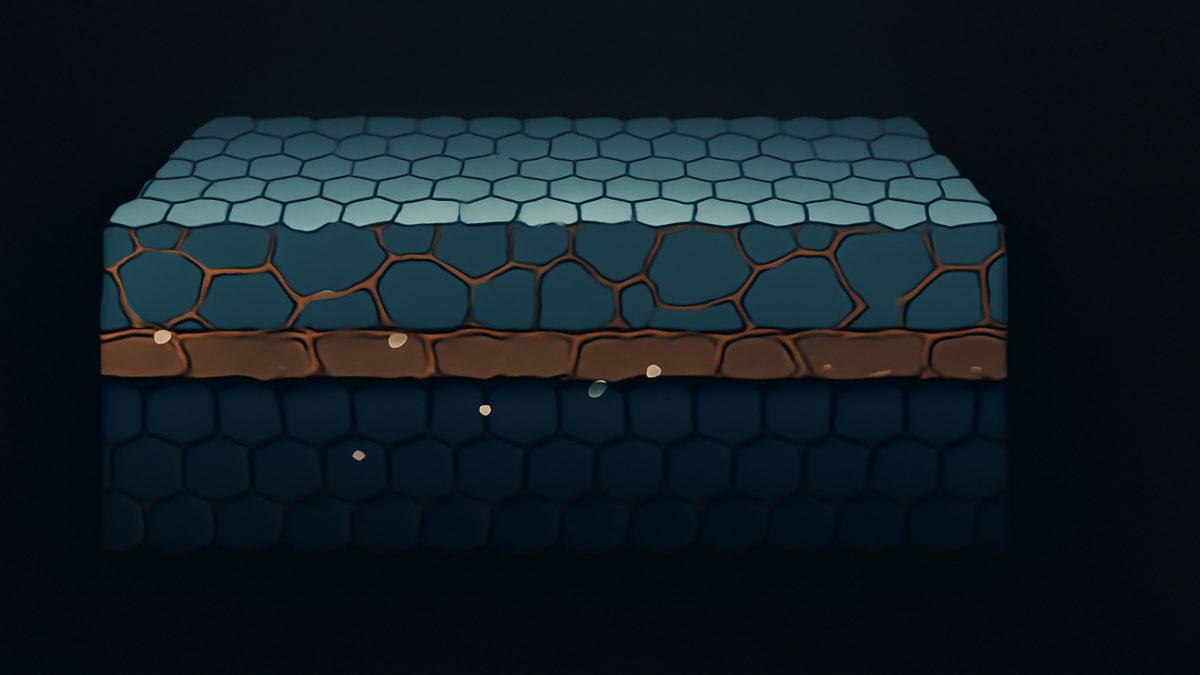
Interphase structure and interfacial degradation set the practical limits on transport, stability and manufacturability across liquid, gel and solid systems this week.
Machine-learning analysis of interphase atomic features now connects nanometer-scale variations directly to macroscopic lithium-ion transport rates, while separate studies on sulfide films, graphite SEI additives and high-temperature nanocoatings show that solvation, surface reconstruction and mechanical contact remain coupled constraints rather than independent variables. Sodium-ion work on hard-carbon microstructures and thick electrodes further illustrates that interface stability, not headline capacity, determines whether cell-level gains survive realistic loadings and cycling windows. The common experimental gap is the absence of combined stack-pressure, temperature and post-mortem data that would test whether the reported mechanisms persist under cell-relevant conditions.
These reports therefore shift attention from conductivity optimization alone to the coupled chemo-mechanical and solvation effects that govern interphase evolution. The unresolved question is which measurement protocols can quantify how local interfacial changes propagate to full-cell failure modes before scale-up decisions are made.
The essentials
Machine-learning mapping of interphase transport. A study using machine learning on interphase atomic features shows how structural variations within a few to tens of nanometers control lithium-ion transport across the electrolyte-electrode boundary. The evidence rests on linking microscopic interphase descriptors to macroscopic performance, yet the work leaves open how these descriptors evolve under continuous cycling or varying electrolyte compositions.
Freestanding sulfide electrolyte films via quasi-dry processing. An additive-assisted quasi-dry route produces freestanding sulfide electrolyte films for all-solid-state cells. The approach targets interfacial contact without liquid solvents, but the data do not yet address critical current density or long-term chemo-mechanical stability under stack pressure.
Graphite SEI reinforcement by electrolyte additive. An electrolyte additive is reported to strengthen the protective layer on graphite, slowing interface evolution during repeated cycling. The mechanistic claim centers on reduced alteration of the graphite-electrolyte boundary, although cell-level retention under fast-charge conditions and varying temperatures remains to be quantified.
Thermally stable nanocoatings on sulfide electrolytes. High-temperature degradation studies of sulfide electrolytes introduce nanocoatings to suppress interfacial reactions. The work supplies degradation-mechanism insights at elevated temperature, but does not report how the coatings affect ionic conductivity or electronic leakage at room temperature and under applied pressure.
Thick-electrode architecture for sodium-ion and lithium-ion cells. Electrode-structure modifications that triple coating thickness while reducing current-collector count are shown to increase energy at constant mass in pouch cells made by industry-standard routes. The result applies to lithium-ion, sodium-ion and zinc-ion formats, yet the impact on tortuosity, rate capability and lithium-inventory loss at high loadings is not detailed.
Mechanism and evidence
The clearest mechanistic signal is the coupling between solvation structure, interphase composition and mechanical contact. Machine-learning work directly ties atomic-scale interphase features to lithium transport, while the graphite-additive and sulfide-nanocoating studies show that surface layers must simultaneously accommodate ion flux and suppress side reactions. Evidence quality is highest where operando or post-mortem characterization links local chemistry to cell-level observables; it weakens where only half-cell cycling or single-temperature data are presented. A recurring limitation is the lack of combined pressure, temperature and depth-of-discharge windows that would reveal whether the proposed interphase mechanisms remain rate-limiting once electrodes reach practical loadings.
Materials and interfaces
Across the reports, SEI and CEI design converge on controlling solvation sheaths and surface reconstruction. The graphite additive targets protective-layer integrity, the sulfide nanocoatings address high-temperature interfacial decomposition, and the quasi-dry film process aims at intimate solid-solid contact. Sodium-ion hard-carbon work similarly emphasizes microstructure control to limit irreversible sodium consumption. In each case the open variable is how these interfaces respond to continuous volume change or to the presence of trace impurities introduced during scale-up.
Scale-up, safety and manufacturing
Thick-electrode processing that reduces current-collector count while maintaining industry-standard pouch-cell fabrication routes offers a concrete manufacturing lever for energy density at constant mass. The quasi-dry sulfide film route similarly points toward solvent-minimized production of solid electrolytes, yet both approaches require verification that electronic conductivity and self-discharge remain controlled once films or thick layers are stacked under realistic pressures. No safety or formation-protocol data are supplied for these modified architectures.
Quick Radar
- Reversible fluorescence analysis: Applied to track Li-metal electrode failure mechanisms in real time.
- Halogen-assisted sulfur oxidation: Examined as a route to controlled cathode interfaces.
- Electrolyte lubricants: Introduced to reduce interfacial friction in solid-state cells.
- Cluster-directed solvation engineering: Stabilizes dual interfaces in gel polymer electrolytes for high-voltage operation.
- Loose Al3+ solvation aggregates: Shown to support reversible aluminum anodes in chlorine-free electrolytes.
- Porous organic polymer cathode: Reported with multiple redox sites for lithium-ion cells.
- Differentiable hybrid force fields: Used to accelerate autonomous electrolyte screening.
- Electronic conductivity of solid electrolytes: Linked to physical self-discharge in solid-state batteries.
Closing
The practical question for the coming week is which single interfacial measurement, performed at cell-relevant stack pressure and temperature, would most rapidly falsify or confirm the transport and degradation mechanisms now being proposed.
Sources
- Journal of Energy Chemistry: Designing high-temperature-stable sulfide electrolytes with thermally stable nanocoatings: Insights from interfacial degradation mechanisms - https://www.sciencedirect.com/user/error/ATN-20?errorContext=arp-ff7d4abf-d989-417d-83b9-9fe335a94d31
- Tech Xplore - Energy & Green Tech: Machine learning uncovers how battery interphases can boost lithium-ion transport - https://techxplore.com/news/2026-09-machine-uncovers-battery-interphases-boost.html
- Tech Xplore - Energy & Green Tech: Electrolyte additive strengthens graphite’s protective layer, extending lithium-ion battery life - https://techxplore.com/news/2026-09-electrolyte-additive-graphite-layer-lithium.html
- Nature Portfolio - Batteries: Additive-assisted quasi-dry process enabling freestanding sulfide electrolyte films for all-solid-state batteries - https://www.nature.com/articles/s41467-026-77590-1
- Nature Portfolio - Batteries: 900°C thermal-force coupling carbonization tailoring hard carbon microstructures enables high performance sodium-ion pouch batteries - https://www.nature.com/articles/s41467-026-77440-0
- Tech Xplore - Energy & Green Tech: More energy at the same weight: Researchers optimize battery cell electrodes - https://techxplore.com/news/2026-09-energy-weight-optimize-battery-cell.html