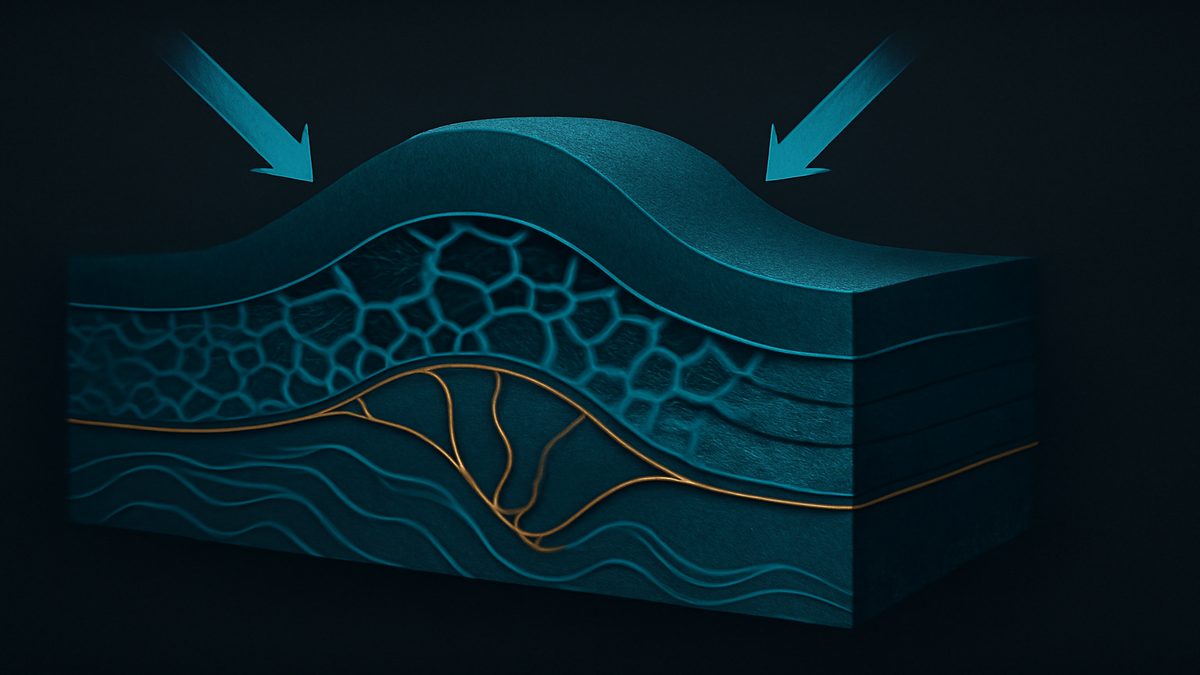
Electrolyte interphases under combined mechanical and chemical stress: composite layers, coatings, and additives are examined for their ability to manage contact, shuttle, and SEI porosity across Li-S and solid-state systems.
Solid-state and lithium-sulfur cells share a recurring constraint: local current constriction and species crossover degrade performance long before bulk conductivity limits are reached. Recent work on layered composite electrolytes shows that stress distribution across interfaces can reduce void formation at the lithium-metal boundary, yet the measurements remain tied to specific stack pressures and cycling windows that are rarely reported in full. In parallel, thin ceramic coatings on polymer separators target polysulfide retention in Li-S cells, but the mechanical integrity of the coating under repeated flexure or volume change is still an open variable.
Phase-field simulations of SEI growth now distinguish dense-to-porous transitions driven by the competition between surface relaxation and stochastic transport noise. These models highlight that the transition time depends on state-of-charge history rather than a single electrolyte property. Such mechanistic detail is useful because it points to formation protocols that could be tested at the electrode level before cell-level claims are made.
The strongest signal this week is therefore the shift from single-parameter electrolyte optimization toward coupled mechanical-chemical descriptions of the interphase. Whether these descriptions survive translation to thicker electrodes or lower stack pressures remains unresolved.
The essentials
Layered composite electrolytes for stress relief. A layered solid electrolyte architecture is reported to homogenize contact stress at the lithium-metal interface in all-solid-state cells. The evidence centers on reduced void formation under cycling, yet the work does not specify the critical current density range or post-mortem interface roughness data that would confirm the mechanism holds across varying stack pressures.
LAGP nanofilm coatings on polyethylene separators. Thin LAGP layers deposited on PE separators are examined for polysulfide retention in Li-S cells. The coating exploits the NASICON structure to block shuttle species while retaining separator flexibility. The principal limitation is the absence of reported data on coating adhesion after repeated bending or on the resulting tortuosity increase for lithium-ion transport.
Al-doped C3N4 composite cathodes in Li-S cells. Composite cathodes incorporating Al-doped C3N4 are shown to reduce polysulfide shuttle while enabling NeuralODE-based lifetime prediction. The mechanistic claim rests on suppressed crossover rather than capacity retention alone. It is unclear whether the same additive loading remains effective at higher sulfur loadings or under lean-electrolyte conditions.
Hybrid phosphate-ether electrolyte for cylindrical Na-ion cells. A phosphate-ether blend is tested in 18650-format sodium-ion cells for elevated-temperature operation. The formulation targets improved safety margins through altered flammability and solvation behavior. Cell-level validation is mentioned, but the work provides no detail on the depth-of-discharge window or the retention threshold used to define acceptable high-temperature performance.
Phase-field modeling of SEI dense-to-porous transition. A phase-field framework tracks the evolution of SEI morphology from dense to porous states under open-circuit conditions. Spatially correlated noise is introduced to capture stochastic transport effects. The model identifies three regimes governed by the balance between interface relaxation and noise-induced roughening, yet experimental validation against specific electrolyte compositions or electrode potentials is not supplied.
Mechanism and evidence
The clearest mechanistic thread is the recognition that mechanical stress and chemical crossover are not independent failure modes. Layered electrolytes aim to redistribute contact pressure, while separator coatings and cathode additives target species transport. Phase-field results add that SEI porosity itself emerges from a noise-relaxation competition that depends on local state of charge. Evidence quality is moderate: several studies supply interface-specific measurements, but few report the full set of conditions (stack pressure, electrolyte volume, electrode loading) needed to judge transferability. The absence of replicated critical-current or shuttle-rate data across independent cells leaves the practical scope of each approach open.
Materials and interfaces
Work on NaSICON-type thin films prepared by ion-beam modification explores thickness reduction as a route to lower area-specific resistance, yet the resulting grain-boundary chemistry and its effect on sodium plating remain unexamined. Polymer electrolytes incorporating cationic chain anchors or zwitterionic-fluorinated networks are presented for wide-temperature lithium-metal and zinc-metal operation; the central question is whether segmental motion improvements also stabilize the cathode interface under high-voltage or high-current conditions. Aliphatic ester chain length and molecular weight are shown to alter interphase composition in lithium-ion systems, but the link between these molecular parameters and long-term lithium inventory loss is not quantified.
Scale-up, safety and manufacturing
A hybrid phosphate-ether electrolyte is evaluated inside 18650 sodium-ion cells specifically for high-temperature safety. The cylindrical format supplies a concrete constraint on electrolyte volume and venting behavior that half-cell tests cannot capture. Real-time mechanical monitoring of cathode brittleness during operation offers a diagnostic route that could be integrated into formation or quality-control lines, provided the method scales beyond laboratory pouch or coin cells. Aerosol release during mechanical recycling of nanomaterial-containing lithium-ion batteries is quantified, underscoring that particle emission profiles depend on the specific cathode chemistry and comminution method.
Quick Radar
- Thin NaSICON films prepared by ion-beam modification raise the question of how grain-boundary chemistry changes with thickness reduction.
- Phase-field SEI modeling identifies a noise-driven dense-to-porous transition whose experimental signature has not yet been mapped to specific electrolyte formulations.
- LAGP-coated PE separators suppress polysulfide shuttle in Li-S cells, but adhesion after flexure is not reported.
- Al-doped C3N4 cathodes enable NeuralODE lifetime forecasting in Li-S cells; the model inputs tied to shuttle rate versus capacity fade remain unspecified.
- Hybrid phosphate-ether electrolytes are tested in 18650 Na-ion cells for high-temperature safety without disclosed depth-of-discharge limits.
- Real-time cathode brittleness monitoring during lithium-ion operation provides a potential in-line diagnostic whose sensitivity to electrode loading is unknown.
- Cationic chain-anchored polymer electrolytes target wide-temperature lithium-metal stability; cathode-interface compatibility data are still limited.
Closing
The recurring experimental gap is whether interface modifications that succeed at low loading or moderate stack pressure continue to control stress and shuttle when electrode thickness or current density increases. Testing that gap directly would sharpen the next round of electrolyte design.
Sources
- arXiv - Battery interphase query: Dense and porous phase transition study of SEI formation using phase-field method - https://arxiv.org/abs/2609.38679v1
- Nature Portfolio - Batteries: Stress homogenization enabled by a layered composite electrolyte for high-performance all-solid-state lithium metal batteries - https://www.nature.com/articles/s41467-026-78129-0
- EKL Batteries: A Hybrid Phosphate-Ether Electrolyte for High-Temperature and High-Safety 18650 Cylindrical Sodium-Ion Batteries - https://pubs.acs.org/aelccp/article-abstract/doi/10.1021/acsenergylett.6c02299/5444139/A-Hybrid-Phosphate-Ether-Electrolyte-for-High?redirectedFrom=fulltext
- arXiv - Solid-state batteries query: Synthesis and modification of thin NaSICON solid electrolytes using ion beams - https://arxiv.org/abs/2609.36758v1
- Nature Portfolio - Batteries: Al-doped C3N4 composite cathodes suppress polysulfide shuttle and enable long-lifetime Li-S batteries with physics-informed NeuralODE lifetime forecasting - https://www.nature.com/articles/s42004-026-02220-2
- arXiv - Battery electrolytes query: Study of LAGP coating on polyethylene separator for polysulfide suppression in thin Li-S batteries - https://arxiv.org/abs/2609.36749v1