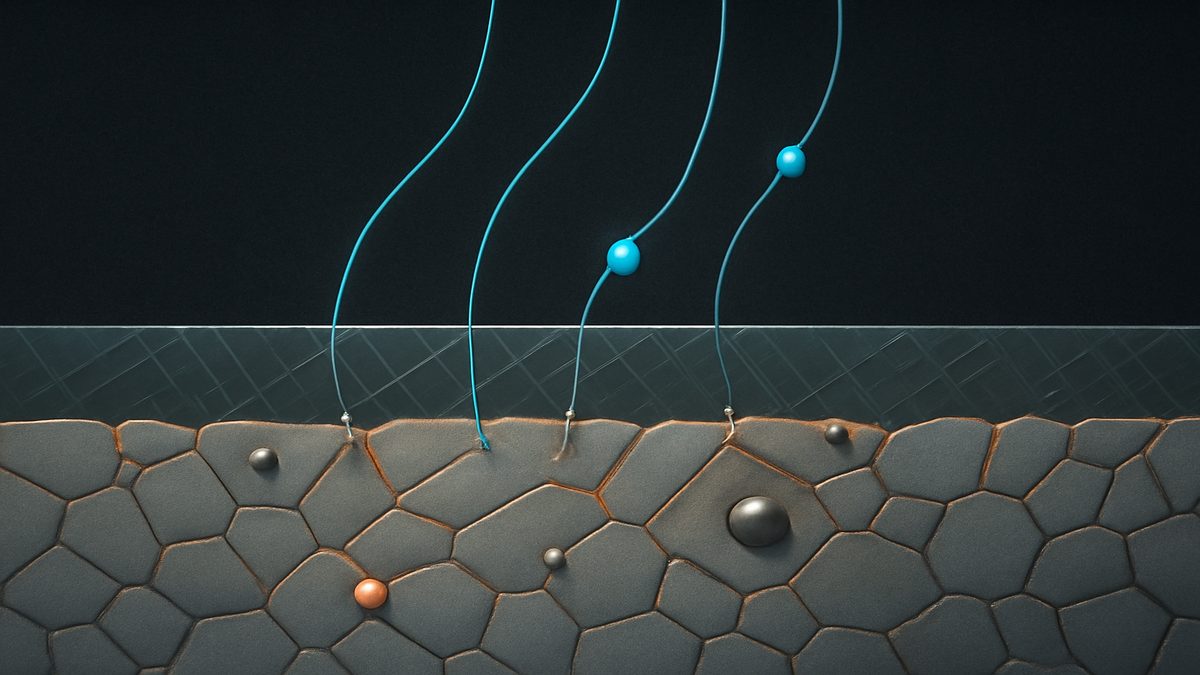
Interphase formation, passivation and spatially resolved degradation now dominate experimental design in solid-state and high-voltage systems.
Recent work on oxyhalide electrolytes, sulfide argyrodites and graphite SEI layers shows that surface reactions, ion redistribution and mechanical contact are not independent variables. Instead, they set the boundary conditions for both charge-transfer kinetics and long-term capacity retention. The shift is visible in the choice of characterization: operando or cryogenic mapping replaces bulk conductivity measurements as the decisive test.
This emphasis on mechanism also changes how recycling and fast-charge protocols are evaluated. Upcycled cathode and anode powders must still form stable interphases under realistic stack pressure and electrolyte volume. Reinforcement-learning controllers for fast charging now incorporate plating-aware penalties derived from the same interfacial data. The common constraint is that any new chemistry or control scheme must survive the same post-mortem evidence threshold.
The essentials
Self-passivating oxyhalide electrolyte A Zr-based oxyhalide superionic conductor forms a self-passivating interphase that supports high-voltage operation and fast charging in all-solid-state cells. The key evidence is the reported stability of the interface under combined electrochemical and mechanical stress. What remains unresolved is the thickness and composition evolution of that interphase after extended cycling at elevated temperature.
Chloride migration and cascading failure in sulfides Cryo-4D-STEM maps show that Li₆PS₅Cl degrades from the surface inward while Li₅.₅PS₄.₅Cl₁.₅ undergoes rapid interior amorphisation accompanied by outward chloride redistribution. DFT calculations link the difference to moisture-induced surface reactions. The open question is whether the observed redistribution alters critical current density under stack pressure typical of pouch or prismatic formats.
Inorganic-rich SEI via liquid-gallium catalysis Liquid gallium promotes formation of an inorganic-rich SEI on graphite, improving high-temperature performance. The mechanism is tied to catalytic interfacial chemistry rather than bulk electrolyte composition. Remaining uncertainty concerns the long-term mechanical integrity of the SEI under repeated lithium inventory loss and volume change.
Quantitative LiF mapping in the SEI Far-infrared spectroscopy combined with a 1D convolutional network enables spatially resolved quantification of LiF within solid electrolyte interphases. The approach supplies a direct metric for comparing electrolyte formulations. Its utility will depend on validation against post-mortem cross-sections from full cells rather than model electrodes.
Dendrite-growth sensing A sensing approach detects dendrite formation before macroscopic short-circuit occurs. The method supplies an early-warning signal that can be integrated with plating-aware fast-charge algorithms. The unresolved engineering step is translation from laboratory half-cells to anode-free or lithium-metal pouch cells under variable stack pressure.
Mechanism and evidence
The strongest mechanistic signal this week is the spatial decoupling of degradation pathways in sulfide solid electrolytes. Surface-localized reactions in low-chloride argyrodite contrast with bulk amorphisation and anion redistribution in high-chloride compositions. Cryo-4D-STEM supplies nanoscale resolution that bulk impedance or XRD cannot match. The evidence quality is high for the initial moisture-exposure stage, yet remains limited for subsequent electrochemical cycling where stack pressure and current constriction become dominant. Parallel work on oxyhalide self-passivation and gallium-catalyzed SEI formation points to the same requirement: interphase composition must be measured locally and tracked over time rather than inferred from average Coulombic efficiency.
Materials and interfaces
Cathode and anode interfaces receive complementary attention. Polymer electrolytes with selective interfacial coupling are examined for Ni-rich cathodes, while eggshell-membrane-derived gradients aim to improve Li⁺ conduction in solid polymer systems. On the anode side, nanoscale LiF island patterning on copper current collectors is tested for anode-free configurations. Across these studies, the recurring limitation is the absence of reported stack-pressure values and the narrow range of electrolyte-to-active-material ratios explored. Without those parameters, it is difficult to judge whether the observed interphase improvements survive realistic cell assembly.
Scale-up, safety and manufacturing
Upcycled cathode and anode powders derived from mixed battery waste produce pouch cells whose cycle life exceeds that of commercial baselines. The result is reported at cell level, yet the mechanism responsible for the improvement is not yet linked to specific changes in SEI or CEI composition. Thermal-safety boundaries for ether-based sodium batteries are also being redefined, but again without published data on electrolyte volume or separator thickness, the practical margin remains unclear. Both efforts highlight the need for post-mortem interfacial analysis on the same cells used for lifetime testing.
Quick Radar
- Reinforcement-learning fast-charge controllers: Now embed state-of-health and plating penalties derived from constant-current constant-overpotential protocols.
- Sulfur-embedded carbon spheres: Regulate sodium deposition and interfacial chemistry in Ah-level sodium-metal cells.
- Nonflammable sulfamoyl-carbonate hybrid electrolytes: Rely on preemptive passivation for high-voltage stability.
- Extruded vs. solvent-cast solid polymer electrolytes: Differ in both ionic transport and mechanical response under compression.
- Stress regulation through precursor chemistry: Affects cycling stability of O3-type layered oxide cathodes.
- Operando CO₂ electrolysis interface studies: Reveal water-gating effects at application-relevant current densities.
Closing
The practical question for the coming week is whether any of the reported interphase improvements can be reproduced in cells that also report stack pressure, electrolyte volume and post-mortem cross-sectional evidence.
Sources
- Nature Portfolio - Batteries: Zr-based oxyhalide superionic electrolyte with self-passivating interphase stabilisation for high-voltage and fast-charging all-solid-state lithium batteries - https://www.nature.com/articles/s41467-026-78813-1
- Nature Portfolio - Batteries: Nonflammable sulfamoyl-carbonate hybrid electrolyte for high-voltage lithium batteries via preemptive passivation - https://www.nature.com/articles/s41467-026-78701-8
- arXiv - Battery degradation query: Visualizing surface-reaction-driven chloride migration and cascading failure in sulfide solid electrolytes - https://arxiv.org/abs/2610.22394v1
- Journal of Energy Chemistry: Quantitative analysis of LiF in solid electrolyte interphases using AMDG-1D CNN and far-infrared spectroscopy - https://www.sciencedirect.com/science/article/abs/pii/S2095495626004742
- Journal of Energy Chemistry: Liquid gallium-catalyzed interfacial chemistry enabling inorganic-rich SEI of graphite anodes - https://www.sciencedirect.com/science/article/abs/pii/S2095495626005279
- Tech Xplore - Energy & Green Tech: Upcycled battery materials roughly double cell cycle life in tests - https://techxplore.com/news/2026-10-upcycled-battery-materials-roughly-cell.html
- Nature Portfolio - Batteries: Batteries that sense dendrite growth - https://www.nature.com/articles/s41578-026-00975-7