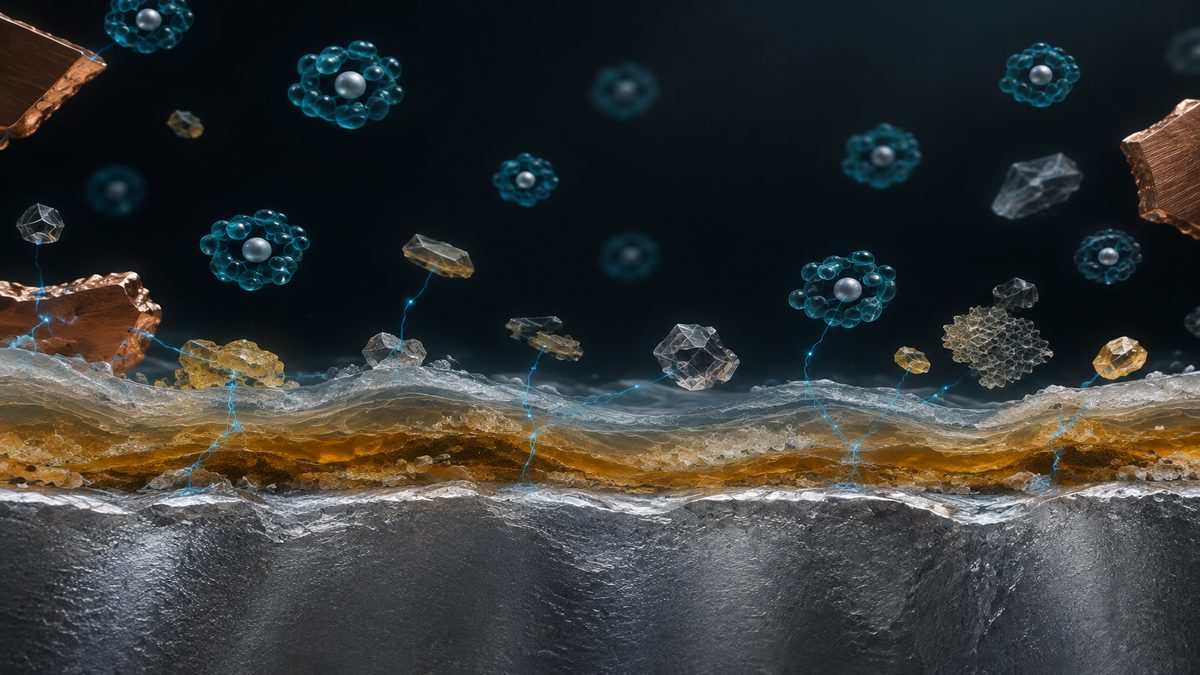
Interphase stability now hinges on coupled electron transport, solvation structure and mechanical boundary conditions rather than isolated additive effects.
The dominant experimental bottleneck in lithium-metal and anode-free cells remains uncontrolled SEI growth driven by electron leakage at the anode. A new modeling framework shows that electron diffusion through the SEI layer itself sets the SOC dependence of capacity fade in LFP/graphite cells, because anode potential directly modulates electron concentration at the inner SEI boundary. This picture aligns with non-destructive angle-resolved XPS measurements that map lithium and organic gradients through the SEI thickness in lithium-metal systems without sputtering artifacts. Both results shift attention from bulk electrolyte reduction to the transport properties inside the already-formed interphase.
Solid-state interfaces introduce an additional mechanical constraint. Atomistic simulations combined with spectroscopy on sulfide electrolytes demonstrate that molecular surface coatings alter both moisture reactivity and Li-ion transport at the solid-electrolyte surface, yet the same coatings must also accommodate local current constriction during stripping. Parallel work on lithium-rich layered oxides indicates that cation disorder can redirect oxygen-redox activity away from surface oxygen loss, but only when the disordered domains remain electronically connected to the bulk lattice.
These observations together frame the practical question for the coming months: which interphase property, electron conductivity, shear modulus or solvation sheath stability, limits cycle life first under realistic stack pressure and variable temperature.
The essentials
Electron-diffusion SEI model. A physically grounded model treats SEI growth as limited by electron diffusion through the existing layer, with electron concentration set by anode potential. Validation across multiple LFP/graphite cell formats and operating conditions shows that the framework reproduces SOC-dependent fade without empirical fitting parameters. The unresolved step is whether the same electron-transport parameters hold when the SEI contains inorganic crystallites or when the electrolyte salt changes.
Protective coatings on sulfides. Large-scale simulations with a machine-learning potential combined with targeted spectroscopy map how molecular coatings on Li6PS5Cl alter surface reactions with moisture and lithium metal. The work isolates molecular-level descriptors for coating adhesion and ion-transport resistance. The open limitation is the absence of long-term cycling data under stack pressure that would reveal whether the coatings also suppress void formation at the lithium interface.
Depth-resolved SEI mapping. Angle-resolved XPS without sputtering provides non-destructive depth profiles of lithium, carbon and oxygen species through SEI layers on lithium metal. The method resolves spatial gradients that conventional depth profiling distorts. It remains unclear how these gradients evolve under fast-charge conditions or when the electrolyte contains fluorinated additives.
Silver-based interface engineering. An additive strategy in anode-free lithium-metal cells reconfigures the initial solid-electrolyte interphase and the current-collector surface simultaneously. The approach improves reversibility by altering lithium nucleation sites. The missing evidence is whether the same additive maintains its effect once the cell reaches higher cumulative lithium throughput and the interface thickens.
Cation disorder in lithium-rich oxides. Structural studies link cation mixing in lithium-rich layered oxides to a redistribution of ligand-hole character that reduces irreversible oxygen release. The result suggests a route to higher practical capacity without immediate surface reconstruction. The critical test is whether the disordered domains remain stable once transition-metal dissolution begins at elevated temperature.
Mechanism and evidence
The clearest mechanistic signal is the direct coupling between anode potential and electron concentration inside the SEI, now supported by both continuum modeling validated on multiple cell formats and spatially resolved XPS. This moves the field beyond simple solvent-reduction pictures toward transport-limited growth kinetics. Evidence quality is higher than typical performance-curve claims because the model reproduces degradation trends across varied electrode loadings and temperatures without retuning. The principal gap is experimental confirmation that electron diffusivity inside the SEI changes measurably with inorganic versus organic content.
Materials and interfaces
Coatings on sulfide solid electrolytes and silver additives in anode-free cells both target the same problem of interfacial instability, yet operate through different levers: surface passivation versus nucleation-site modification. In zinc systems, ionic-liquid additives and dynamic hydrogel networks similarly aim to regulate solvation and SEI formation, but the zinc interphase chemistry remains less constrained by electron leakage than its lithium counterpart. Lithium-rich cathode work shows that lattice-level cation disorder can redirect oxygen redox away from the surface, offering a materials handle that complements interphase engineering.
Scale-up, safety and manufacturing
Covalent incorporation of phosphorus flame retardants into gel polymer electrolytes provides a route to improved safety without liquid additive migration. The approach fixes the retardant within the polymer network, reducing the risk of loss during formation or cycling. No cell-level abuse data or manufacturing compatibility metrics are supplied, so the practical constraint remains whether the fixed retardant alters ionic conductivity or SEI composition at the electrode interfaces.
Quick Radar
- Operando electro-rheology: Operando electro-rheology on block-copolymer electrolytes decouples ion transport from mechanical modulus under applied current.
- Zeolite electrolyte for zinc-iodine cells: A single-atom-doped zeolite is reported as a quasi-solid electrolyte for zinc-iodine cells, but transport numbers and interfacial resistance data are still needed.
- Low-chloride zinc-iodine electrolytes: Low-chloride electrolytes for four-electron zinc-iodine redox rely on orbital coupling effects whose stability under repeated plating/stripping is untested.
- Vacancy-enhanced lithium anodes: Vacancy-enhanced lithium solid-solution anodes are screened computationally for higher critical current density in solid-state cells; experimental CCD values under realistic pressure are absent.
- Surfactant-mediated electrolytes: Surfactant-mediated oil-in-water electrolytes for aqueous zinc batteries target low-dielectric interfacial layers, yet long-term zinc morphology data are not shown.
Closing
The immediate experimental priority is to test whether electron-transport parameters extracted from the SEI model remain predictive once stack pressure, temperature cycling and varying electrolyte volume are introduced in the same cell format.
Sources
- Nature Portfolio - Batteries: Determining depth-resolved spatial distribution of solid-electrolyte interphase using non-destructive angle-resolved X-ray photoelectron spectroscopy for lithium-metal batteries - https://www.nature.com/articles/s41467-026-78168-7
- arXiv - Battery interphase query: Consistent Modeling of SEI Growth via Electron Diffusion Validated Across Diverse Cell Specifications and Operating Conditions in LFP/Graphite Cells - https://arxiv.org/abs/2610.29775v1
- Tech Xplore - Energy & Green Tech: No lithium metal anode to start? Silver-based additive helps stabilize next-generation batteries - https://techxplore.com/news/2026-10-lithium-metal-anode-silver-based.html
- arXiv - Battery degradation query: Combining Simulations and Spectroscopy to Design Protective Coatings on Sulfide Solid Electrolytes - https://arxiv.org/abs/2610.32905v1
- Tech Xplore - Energy & Green Tech: Cation disorder could improve lithium-rich cathodes, study shows - https://techxplore.com/news/2026-10-cation-disorder-lithium-rich-cathodes.html