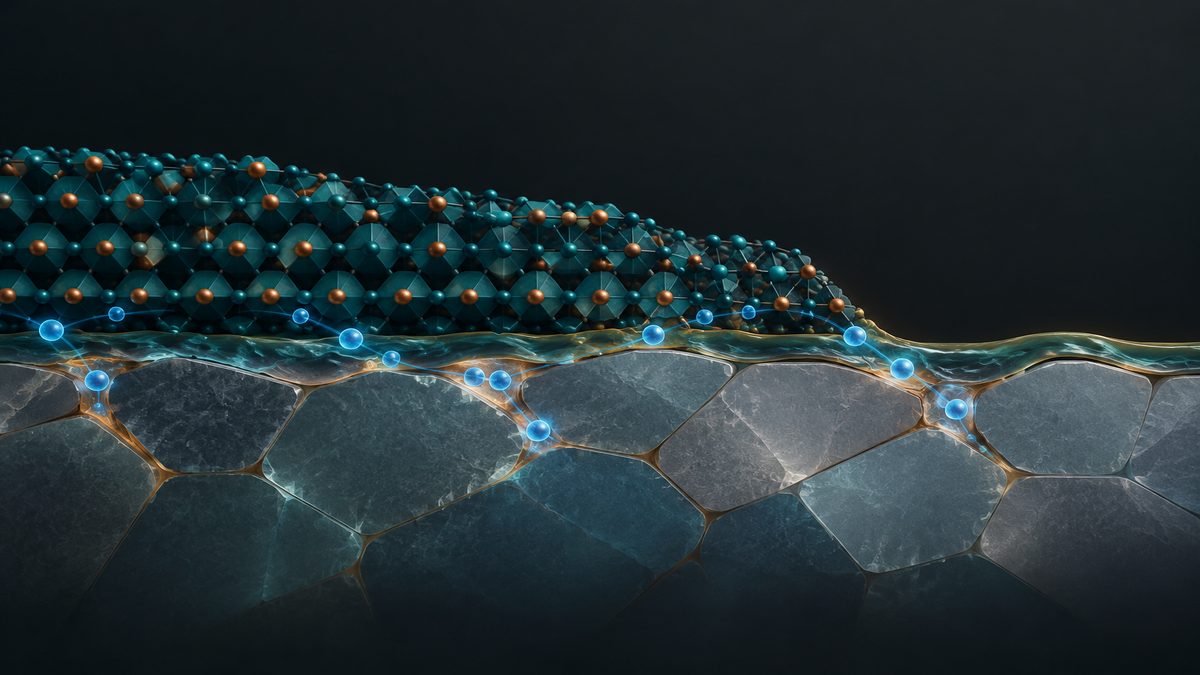
Interphase formation and interfacial contact remain the rate-limiting steps across solid-state, aqueous zinc, and sodium-metal platforms.
Solid-state batteries continue to show that bulk conductivity gains are quickly overtaken by contact loss and interphase growth at the electrode-electrolyte boundary. Recent work on halide electrolytes demonstrates that an in-situ polymer layer can be grown directly on the solid electrolyte surface through Lewis-acid initiation, creating a compliant buffer that accommodates volume change while limiting further decomposition at high voltage. The same constraint appears in aqueous zinc systems, where particle-level polymer coatings on zinc powder anodes are being tested to stabilize both the metal-electrolyte interface and particle-particle electronic contact.
Sodium-metal and zinc-metal anodes face parallel stability problems driven by continuous electrolyte consumption and dendrite-induced shorting. Electrolyte redesigns that reduce flammability or alter solvation are reported, yet the data remain at the half-cell or symmetric-cell stage, leaving open the question of how the new formulations behave under full-cell conditions with realistic areal capacities. Characterization advances, such as cryogenic XPS protocols for lithium salts, are intended to reduce beam-induced artifacts that have previously obscured salt decomposition pathways.
Oxygen-release phenomena in layered-oxide cathodes are now linked to capacity recovery rather than only degradation, shifting attention from bulk structural collapse to surface reconstruction kinetics. These observations reinforce that interfacial chemistry and mechanical contact must be treated as coupled variables rather than sequential optimization targets.
The essentials
Adaptive interphase on halide electrolytes Lewis-acid-induced polymerization is used to grow a flexible layer directly on halide solid electrolytes for high-voltage all-solid-state cells. The approach targets both interfacial decomposition and mechanical contact loss, yet post-mortem evidence of layer thickness evolution and critical current density under stack pressure is still required to confirm long-term stability.
Dual-polymer coating on zinc powder anodes A particle-level dual-polymer interphase is applied to zinc metal powder to address both the electrochemical interface and electronic contact between particles in aqueous zinc-ion cells. The work emphasizes coupled interfacial and contact stabilization, but the translation from powder-level measurements to practical electrode loadings remains unresolved.
Nonflammable electrolyte for sodium-metal batteries An electrolyte formulation is presented that improves durability and reduces flammability in sodium-metal systems. The central claim rests on safety and stability improvements, yet full-cell cycling data that include sodium inventory loss, temperature dependence, and separator interactions are not yet reported.
Cryogenic XPS protocol for lithium electrolytes A measurement protocol minimizes artifacts during XPS analysis of sensitive lithium salts and electrolyte solutions. The method is positioned to clarify decomposition pathways that conventional room-temperature measurements distort, leaving open how the refined spectra will alter existing models of SEI growth in high-voltage or solid-state configurations.
Oxygen-release behavior in layered oxides Oxygen release from a cathode material is shown to correlate with increased usable capacity upon cycling. The observation reframes oxygen activity from a purely degradation mechanism to one that can be harnessed, but the structural and surface conditions that separate beneficial from detrimental release still require clarification.
Mechanism and evidence
The strongest mechanistic signal this week is the repeated demonstration that interphase compliance and electronic contact must be engineered together rather than independently. In halide solid electrolytes, the polymer layer is grown in place to accommodate chemo-mechanical strain; in zinc powder anodes, the dual-polymer coating simultaneously passivates the metal surface and bridges particle contacts. Both approaches recognize that loss of physical contact accelerates further electrolyte consumption. Evidence quality remains limited to material-level or symmetric-cell demonstrations; cell-level stack-pressure requirements, critical current density values, and post-cycling interfacial morphology are not yet supplied for most systems.
Materials and interfaces
Work on zinc and sodium anodes continues to focus on solvation sheath modification and artificial interphase layers to suppress continuous reduction of the electrolyte. Halloysite-cellulose coatings on zinc are reported to improve desolvation kinetics, while locally competitive coordination electrolytes are explored for Ni-rich lithium-metal cells. On the cathode side, defect engineering of degraded LiCoO2 via vacancy creation is presented as a regeneration route, yet the reversibility of the reinforced structure under repeated lithium extraction remains to be quantified. Cryogenic XPS is positioned to resolve salt-derived species that conventional measurements misassign.
Scale-up, safety and manufacturing
Safety-oriented electrolyte redesigns for sodium-metal batteries target flammability reduction, but the formulations have not yet been evaluated in large-format cells where heat propagation and gas evolution become dominant. Sulfur-flow-battery translation work highlights system-level deployment constraints, while tin-based flow electrolytes are shown to access additional electron transfer through solvent changes; both remain at the laboratory cell stage. No concrete manufacturing metrics such as coating uniformity, drying rates, or electrode tortuosity are provided for the interphase strategies.
Quick Radar
- Cryogenic XPS protocols: Aim to reduce beam damage during lithium-salt analysis but have not yet been applied to solid-electrolyte interphases.
- Li3Ga2 anodes: Reported for all-solid-state cells with antisite-enhanced diffusivity; stack-pressure dependence of deposition overpotential is still needed.
- Silicon-sulfur cell stabilization: Via xerogel-silicon anodes and interfacial networks leaves open the question of polysulfide shuttle under lean-electrolyte conditions.
- Machine-learning interatomic potentials: Distilled for electrolyte transport prediction, yet validation against experimental conductivity and transference numbers at relevant concentrations is pending.
- Data-centre demand: Cited as a potential driver for sodium-ion adoption in Europe, without accompanying cell-level cycle-life or temperature-window data.
- Bismuth telluride anodes: For sodium-ion batteries show kinetic improvements through dual-anion coordination; full-cell retention under fast-charge conditions remains unstated.
Closing
The recurring observation across chemistries is that interphase compliance and contact retention must be solved simultaneously; the practical question for the coming week is which measurement protocol will first quantify both quantities under realistic stack pressure and electrolyte volume.
Sources
- EKL Batteries: Constructing an Adaptive Flexible Interphase on Halide Electrolytes by Lewis-Acid-Induced Polymerization for High-Voltage All-Solid-State Lithium Batteries - https://advanced.onlinelibrary.wiley.com/doi/10.1002/aenm.71780?af=R
- EKL Batteries: A Particle-Level Dual-Polymer Interphase for Coupled Interfacial and Contact Stabilization of Zinc Metal Powder Anodes in Aqueous Zinc-Ion Batteries - https://advanced.onlinelibrary.wiley.com/doi/10.1002/adfm.79402?af=R
- Journal of Energy Chemistry: Halloysite/cellulose interfacial layer for aqueous zinc-ion batteries - https://www.sciencedirect.com/science/article/abs/pii/S2095495626005310
- EKL Batteries: Ultralow Deposition Potential and Antisite-Boosted Diffusivity of Li3Ga2 Anode for All-Solid-State Batteries - https://pubs.acs.org/aelccp/article-abstract/doi/10.1021/acsenergylett.6c02308/5461895/Ultralow-Deposition-Potential-and-Antisite-Boosted?redirectedFrom=fulltext
- Tech Xplore - Energy & Green Tech: Researchers develop nonflammable and more durable electrolyte for sodium metal batteries - https://techxplore.com/news/2026-10-nonflammable-durable-electrolyte-sodium-metal.html
- Tech Xplore - Energy & Green Tech: Electrolyte redesign unlocks tin’s full charge capacity for flow batteries - https://techxplore.com/news/2026-10-electrolyte-redesign-tin-full-capacity.html
- Journal of Energy Chemistry: Cryogenic XPS protocol for lithium salts and electrolytes - https://www.sciencedirect.com/science/article/abs/pii/S2095495626005292
- Tech Xplore - Energy & Green Tech: The unexpected key to extending EV battery life found in ‘oxygen release’ - https://techxplore.com/news/2026-10-unexpected-key-ev-battery-life.html
- Journal of Energy Chemistry: Defect-driven upcycling of degraded LiCoO2 via vacancy-enabled structural reinforcement - https://www.sciencedirect.com/science/article/abs/pii/S2095495626004766